
Foundations Built for Rhode Island Weather
Concrete Pads & Patios in North Scituate for surfaces that resist freeze-thaw damage and drainage failure
Kugler Dirtworks prepares level, compacted foundations for concrete pads and patios across North Scituate and surrounding Rhode Island communities. The site preparation determines whether your concrete surface lasts decades or develops cracks and settlement within a few years. Rhode Island's freeze-thaw cycles place specific demands on base preparation, compaction density, and drainage slope that directly affect how concrete performs through winter expansion and spring thaw.
This work involves precise grading to specification, mechanical compaction of base material, and drainage setup that directs water away from the concrete surface. The finish grading creates the exact slope and elevation needed so that water runoff moves predictably and the concrete installer pours on a stable, uniform base. Poor compaction or incorrect slope allows water to pool under the slab, where it freezes, expands, and eventually cracks the concrete from below.
Schedule a site evaluation to review slope requirements and base preparation for your concrete project..
What Proper Base Preparation Prevents Long-Term
The base preparation process begins with excavation to the specified depth, followed by grading that establishes the drainage slope and removes high spots or soft soil. Mechanical compaction then consolidates the base material in lifts, creating a dense, stable platform that resists settling under the weight of the concrete. A third-generation operator adjusts compaction passes and material depth based on soil conditions observed during excavation, which vary across Rhode Island's glacial till and ledge formations.
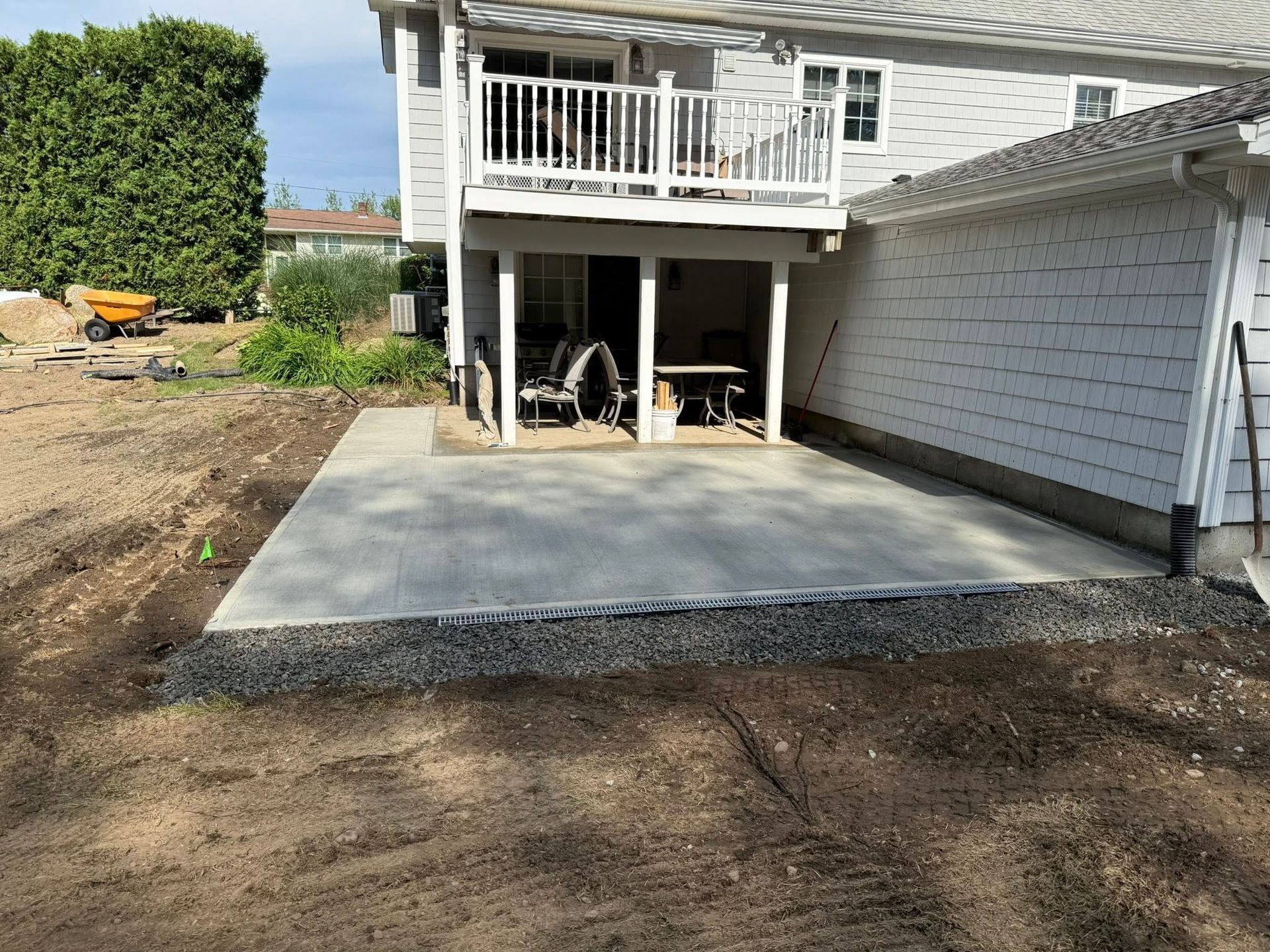
Once the pad is complete, you'll see a level surface with visible drainage slope, uniform compaction across the entire area, and clean edges that match the concrete dimensions. Water that falls on the finished concrete moves predictably toward drainage areas rather than pooling on the surface or collecting underneath. The slab remains stable through seasonal ground movement because the compacted base distributes weight evenly and prevents differential settling that causes cracks.
The preparation includes coordination with concrete installers to confirm elevation benchmarks, edge forms, and any utility penetrations. The finished grade must meet tight tolerance requirements because even small deviations affect how the concrete cures and how water drains. If ledge or unsuitable soil appears during excavation, the operator adjusts the base depth or material type to maintain structural performance..
Questions Before Starting Your Project
Property owners preparing for concrete work often ask about base preparation requirements, material specifications, and how local soil conditions affect the foundation.
What depth of base material does a concrete patio require?
Most residential patios in Rhode Island require four to six inches of compacted gravel base, but the exact depth depends on soil type, intended load, and whether ledge or soft soil appears during excavation.
How does freeze-thaw cycling affect concrete pads in North Scituate?
Water that penetrates beneath the concrete freezes during winter, expands, and lifts the slab, which creates cracks and uneven sections over multiple freeze-thaw cycles unless proper base preparation and drainage slope prevent water accumulation.
What happens during the site preparation process?
Excavation removes topsoil and unsuitable material to the specified depth, followed by grading that establishes drainage slope, then mechanical compaction of base material in lifts until density testing or visual inspection confirms the base is stable and ready for concrete installation.
When should I schedule site prep for a concrete project?
Site preparation typically occurs immediately before concrete installation to prevent base material from becoming saturated or disturbed, though scheduling depends on weather conditions, concrete contractor availability, and whether utility work needs to happen first.
What should I look for in finished site preparation?
The finished base should appear uniformly compacted with no soft spots, show visible drainage slope away from structures, have clean edges that match concrete dimensions, and display no standing water after rain.
Kugler Dirtworks applies third-generation excavation expertise to foundation preparation that supports long-term concrete performance across Rhode Island's varied soil conditions. Request a detailed estimate based on your site's specific dimensions and soil characteristics.